
Somalia Court Rules President's Hassan Sheikh Term Extension Illegal
In its ruling on Thursday, the court declared that constitutional amendments extending the president's four-year mandate by one year could not be applied retrospectively to his current term, which expired in May.

Somalia has been plunged into a fresh political crisis after the Supreme Court ruled that President Hassan Sheikh Mohamud unlawfully extended his tenure, intensifying tensions between the presidency and the judiciary.
In its ruling on Thursday, the court declared that constitutional amendments extending the president's four-year mandate by one year could not be applied retrospectively to his current term, which expired in May.
The court also ordered political leaders to reach an agreement on an electoral roadmap within 30 days and conduct elections within 90 days, a decision that could disrupt the government's plan to hold nationwide elections next year.
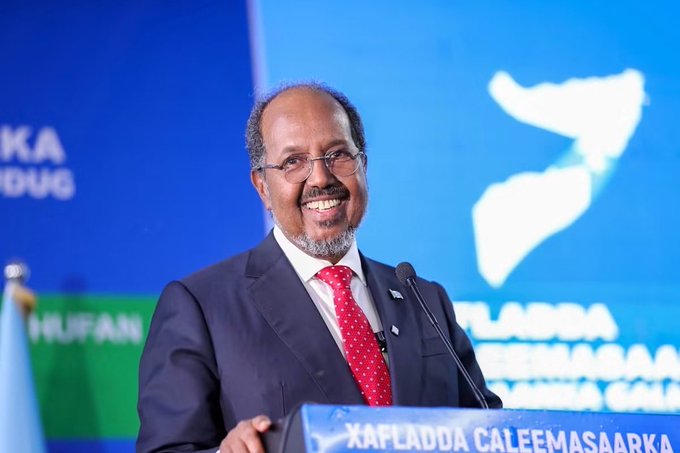
The ruling came a day after President Mohamud dismissed Chief Justice Bashe Yusuf Ahmed, a move the Supreme Court subsequently declared null and void, arguing that the president lacked the constitutional authority to remove the judicial head outside established legal procedures.
The presidency had defended the dismissal, saying it followed complaints over the administration of justice and was aimed at promoting a fair and transparent judiciary. Mohamud also appointed Ibrahim Idle Suleiman, a former holder of the position, as Ahmed's replacement.
However, the court maintained that the removal of the chief justice must follow constitutionally prescribed procedures, warning against interference with judicial independence.
Mohamud's administration extended his tenure through constitutional amendments approved by parliament in March. The government has defended the reforms as necessary to strengthen democratic institutions and transition Somalia from its longstanding clan-based electoral system, under which traditional elders select representatives, to a system of universal suffrage.
However, opposition groups have accused the president of using the constitutional changes to remain in power beyond his constitutionally approved mandate.
Former Somali President Sharif Sheikh Ahmed welcomed the Supreme Court's decision, describing the situation as a serious political crisis and urging Mohamud to embrace dialogue and a consensus-based approach.
The dispute escalated further on Thursday after former Prime Minister Hassan Ali Khaire accused the president of deploying security forces to the Supreme Court and attempting to arrest the chief justice.
Khaire described the alleged action as an assault on the judiciary, warning that Somalia was facing a dangerous political situation.
He said the weakening of the judiciary posed a direct threat to the rule of law and the country's democratic institutions.
Although the AFP news agency said it could not independently verify the reported deployment of security personnel, photographs circulating in Somali media appeared to show armed security officers inside the Supreme Court compound.
The latest developments have also cast uncertainty over Somalia's electoral timetable. The country's electoral commission has scheduled parliamentary elections for April 15, 2027, followed by a presidential election a month later.
However, opposition groups and the regional administrations of Puntland and Jubaland have rejected the proposed timetable, further complicating efforts to reach a political settlement.
In an attempt to resolve the impasse, President Mohamud has called for national talks scheduled to take place from November 14 to 18. Opposition leaders, however, have questioned his legitimacy to convene the discussions amid the ongoing dispute over his tenure.
The political crisis comes at a particularly sensitive time for Somalia, which continues to battle the Islamist militant group al-Shabaab, which maintains control over significant parts of the countryside despite years of military operations.
Concerns over the country's security situation have also increased following Uganda's announcement this week that it intends to withdraw its troops from Somalia by the end of the year.
Uganda is the largest troop-contributing country to the African Union mission supporting Somalia's fight against al-Shabaab.
With tensions rising between the presidency, judiciary and opposition, Somalia now faces growing pressure to resolve its constitutional dispute and agree on a credible electoral process to prevent further political instability.
Comments (0)