
Uganda Denies Ebola Outbreak Claims After Nigeria Confirms Case
The development comes amid regional concerns over the spread of Ebola, particularly the ongoing outbreak linked to the Bundibugyo virus in the Democratic Republic of the Congo (DRC).
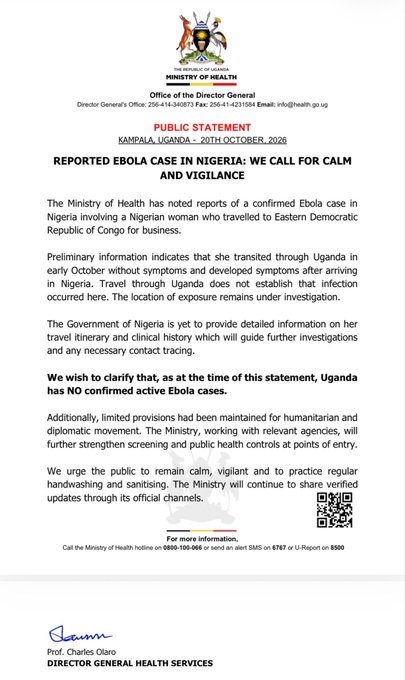
Uganda’s Ministry of Health has denied reports of an Ebola outbreak in the country following Nigeria’s confirmation of an imported case of the disease in the Federal Capital Territory (FCT).
The Nigerian government confirmed the case on Tuesday, involving a woman who recently travelled from Uganda and developed symptoms after returning to Nigeria.
Coordinating Minister of Health and Social Welfare, Muhammad Pate, disclosed at a media briefing in Abuja that laboratory tests confirmed the infection.
According to Pate, the woman returned to Nigeria with symptoms on October 7, which worsened four days later before the diagnosis was confirmed.
He said the patient had initially received treatment at a private hospital before being placed in isolation, where she is currently receiving medical care.
The minister added that contact tracing had commenced, with 44 contacts identified, while surveillance was being strengthened at the country’s entry points to prevent further transmission.
Pate said the Federal Ministry of Health, the FCT Health Secretariat, the Africa Centres for Disease Control and Prevention, and other partners were working together to contain the infection.
He urged healthcare facilities to remain vigilant and advised Nigerians to maintain good hygiene, monitor possible symptoms and cooperate with public health officials.
However, Uganda’s Ministry of Health said the location where the Nigerian patient contracted the virus remained under investigation.
In a statement issued on Tuesday, the ministry maintained that travelling through Uganda alone was insufficient to establish that the infection originated in the country.
It also said Nigeria had yet to provide detailed information about the woman’s travel itinerary and clinical history, which it considered necessary for further investigations and contact tracing.
The Ugandan ministry added that it was working with relevant agencies to strengthen screening and public health measures at points of entry.
The development comes amid regional concerns over the spread of Ebola, particularly the ongoing outbreak linked to the Bundibugyo virus in the Democratic Republic of the Congo (DRC).
Kenya, which confirmed its first imported case in early October, reported a ninth case on Tuesday. Its health ministry said all nine infections belonged to a single known cluster, with the eight surviving patients responding well to supportive care.
The first patient in Kenya had reportedly travelled from the DRC through Uganda before arriving in Nairobi, raising concerns about the cross-border movement of the virus.
Uganda also recorded Ebola infections earlier in 2026 but subsequently declared its outbreak over after completing the required period without a new confirmed case.
Ebola is transmitted through direct contact with the blood or other bodily fluids of an infected person, or contaminated materials. Symptoms may include fever, headache, severe weakness, vomiting and diarrhoea.
Nigerian health authorities have urged the public to remain calm as surveillance and contact-tracing efforts continue.
Comments (0)